
In an era where traditional television viewership continues to decline, marketers face a rapidly evolving landscape of digital video consumption. Over-the-top (OTT) and connected TV (CTV) platforms have emerged as dominant forces, reshaping how audiences discover, engage with, and respond to advertising. Understanding the nuanced distinctions between these two delivery methods is no longer optional—it is essential for crafting effective campaigns that reach viewers where they are most attentive. As streaming services proliferate and smart devices become ubiquitous, grasping these differences empowers marketers to allocate budgets more strategically, optimize targeting precision, and ultimately drive stronger returns on investment.
The Evolution of Video Consumption
The shift from linear broadcasting to on-demand digital video represents one of the most significant transformations in media history. Consumers increasingly favor flexibility, choosing when, where, and on what device they watch content. This behavioral change has fragmented audiences across countless platforms, compelling brands to rethink their approach to video advertising. While both OTT and CTV fall under the umbrella of streaming, they operate through distinct technical architectures and user experiences that influence everything from ad delivery to measurement capabilities.
Defining OTT: Streaming Beyond Traditional Bounds
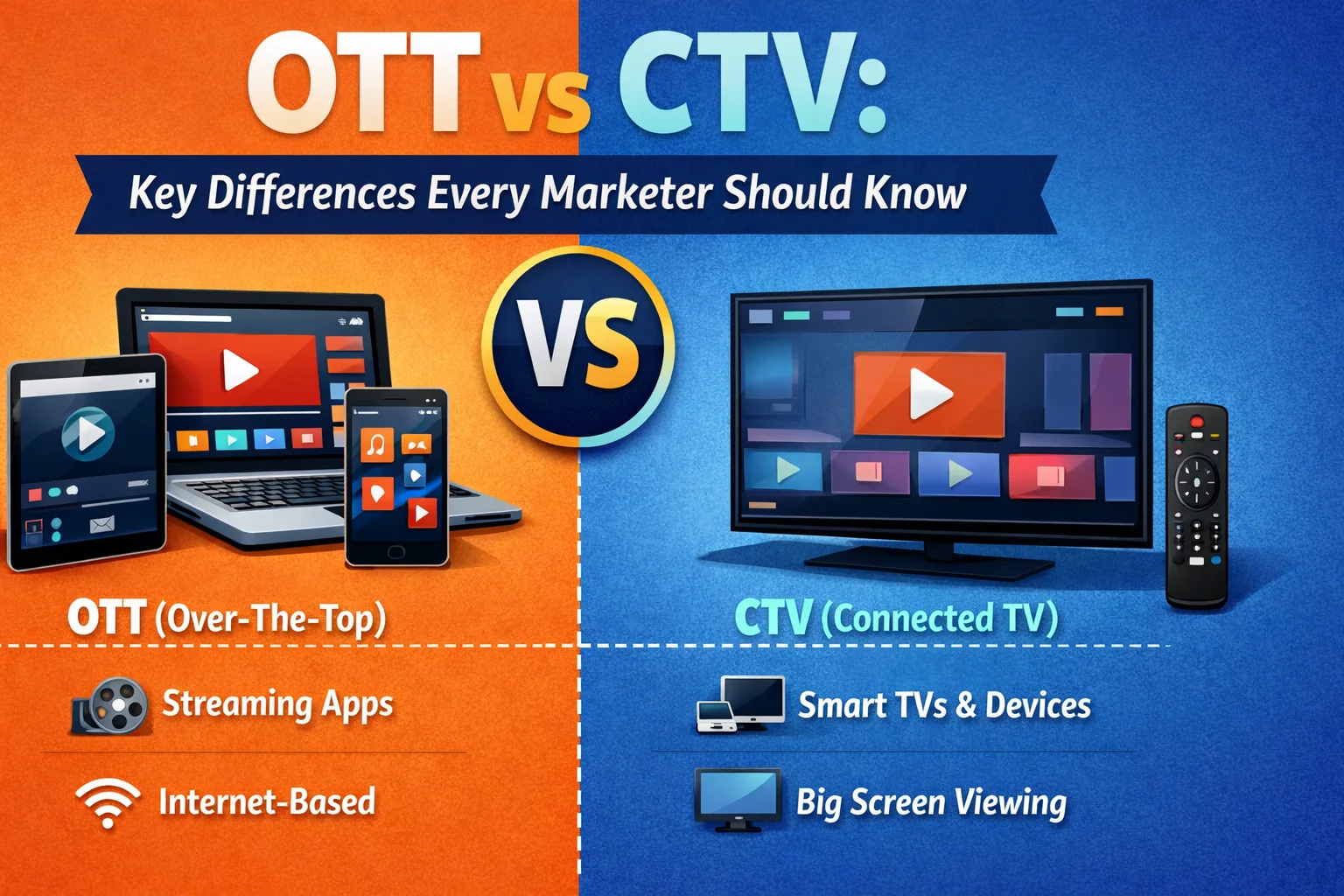
Over-the-top refers to the delivery of video content directly via the internet, bypassing conventional cable, satellite, or broadcast infrastructure. This method allows providers to stream programming to any internet-connected device, including smartphones, tablets, laptops, and smart TVs. OTT encompasses a broad spectrum of services, from subscription-based platforms like Netflix and Disney+ to ad-supported options and live streaming channels. Its defining characteristic lies in the independence from managed networks; content travels over public internet connections, offering unparalleled accessibility but introducing variables such as bandwidth fluctuations and device diversity.
From a marketer’s perspective, OTT opens doors to highly personalized experiences. Campaigns can leverage user data from app logins, viewing histories, and behavioral signals to serve contextually relevant ads. However, this freedom comes with challenges in standardization, as ad formats and quality can vary widely depending on the device and connection speed. Marketers must account for potential interruptions in playback and ensure creative assets perform consistently across a fragmented ecosystem.
Understanding CTV: The Smart Television Experience
Connected TV, by contrast, specifically denotes internet-enabled television sets or devices that connect to the internet for streaming purposes. These include smart TVs from manufacturers like Samsung and LG, as well as external streaming devices such as Roku, Apple TV, Amazon Fire TV, and gaming consoles. CTV transforms the living room television into a gateway for on-demand and live streaming content, often replicating the familiar large-screen viewing environment that traditional broadcast once dominated.
What sets CTV apart is its focus on the television screen as the primary interface. Content delivery occurs through dedicated apps or channels optimized for bigger displays, delivering higher resolution and immersive audio that enhance viewer engagement. For advertisers, this environment provides a more captive audience, as users tend to watch in a lean-back posture rather than the lean-forward mode common with mobile devices. Ad placements on CTV often feel more integrated into the viewing session, resembling the commercial breaks of legacy television while benefiting from digital precision.
Core Technical Distinctions
At their foundation, OTT and CTV differ in scope and specificity. OTT serves as the broader category, encompassing any internet-delivered video regardless of screen size or device type. CTV represents a subset of OTT, limited to experiences designed explicitly for television sets and their associated viewing contexts. This hierarchical relationship means all CTV streaming qualifies as OTT, but not all OTT qualifies as CTV—mobile and desktop streaming fall outside the CTV realm.
Technically, CTV platforms benefit from more robust infrastructure integrations. Many operate through proprietary ecosystems with dedicated hardware acceleration, ensuring smoother playback and fewer buffering issues on large screens. OTT, while versatile, must accommodate a wider array of operating systems and screen resolutions, which can complicate ad rendering and tracking. Marketers evaluating these channels should consider how these technical underpinnings affect campaign scalability and creative development.
Audience Behavior and Engagement Patterns
Viewer habits diverge noticeably between OTT and CTV environments. On OTT platforms accessed via mobile or desktop, audiences often engage in shorter, more distracted sessions—multitasking while commuting, working, or browsing social media. This fragmented attention demands concise, visually striking creatives that capture interest within seconds. CTV viewing, however, mirrors traditional television more closely, with longer dwell times and fewer distractions. Families or individuals settle in for evening entertainment, creating opportunities for deeper storytelling and emotional brand connections.
Data from industry reports consistently highlight these patterns. CTV households demonstrate higher completion rates for longer-form content, while OTT on smaller screens sees more frequent pauses and exits. Savvy marketers use this insight to segment campaigns: high-impact, narrative-driven spots for CTV and quick-hit, interactive elements for broader OTT reach.
Targeting Capabilities and Data Utilization
One of the most compelling advantages of both channels lies in advanced targeting, yet the mechanisms differ. OTT benefits from cross-device user profiles, drawing on login data, IP addresses, and app-specific behaviors to build comprehensive audience segments. This enables hyper-personalization, such as serving different ad variations based on a user’s recent searches or purchase history.
CTV targeting, while also sophisticated, often relies more heavily on household-level identifiers and deterministic matching through device registration. Privacy regulations have pushed the industry toward privacy-safe solutions like hashed emails or contextual signals, but CTV’s living-room context allows for powerful demographic and geographic precision. Brands targeting families, for instance, find CTV particularly effective due to its shared viewing environment. The key for marketers is layering these capabilities—using OTT for broad acquisition and CTV for high-intent conversion nurturing.
Ad Formats and Creative Considerations
Creative execution must adapt to the unique constraints and opportunities of each channel. OTT supports a diverse range of formats, including pre-roll, mid-roll, and post-roll videos, as well as interactive overlays on mobile. The variability in screen sizes requires responsive design, ensuring ads remain legible and impactful whether viewed on a phone or laptop.
CTV advertising leans toward full-screen, non-skippable or skippable video spots that align with the premium feel of television. Many platforms offer innovative options like dynamic ad insertion, where commercials are seamlessly woven into live or on-demand streams based on real-time audience data. Marketers should prioritize high-production-value assets for CTV, capitalizing on the larger canvas to showcase products with cinematic quality, while reserving more experimental, lower-fidelity tests for OTT’s experimental edges.
Measurement and Attribution Challenges
Accurate performance tracking represents a perennial hurdle in digital video, amplified by the distinctions between OTT and CTV. OTT measurement benefits from granular, user-level data across devices, facilitating advanced attribution models that link exposures to website visits or app downloads. Tools can track viewability, completion rates, and even engagement signals like pauses or rewinds.
CTV measurement has matured rapidly, with dedicated platforms providing household-level insights and lift studies that compare exposed versus control groups. Incremental reach becomes easier to quantify on CTV due to its distinct device footprint, helping marketers understand true incremental impact beyond digital cannibalization. However, cross-channel attribution remains complex, requiring unified dashboards that reconcile OTT’s device fluidity with CTV’s screen-specific data.
Strategic Implications for Budget Allocation
Marketers must approach budget decisions with a clear understanding of these differences to maximize efficiency. OTT often delivers cost-effective scale, ideal for awareness campaigns aiming to reach younger, mobile-first demographics at lower CPMs. Its flexibility suits testing multiple creative variations and rapid optimization based on real-time performance.
CTV, commanding premium pricing in many cases, justifies investment through superior engagement metrics and brand recall. It excels in performance-driven objectives where emotional resonance and trust-building matter, such as automotive, finance, or consumer packaged goods categories. A hybrid strategy—allocating portions to each based on funnel stage—frequently yields the best outcomes: OTT for top-of-funnel discovery and CTV for bottom-funnel persuasion.
Navigating Regulatory and Privacy Landscapes
Both OTT and CTV operate under intensifying scrutiny regarding data privacy and advertising standards. Regulations like GDPR in Europe and CCPA in California compel platforms to adopt consent management and anonymized targeting. Marketers should stay vigilant about platform-specific compliance features, ensuring campaigns respect user preferences while maintaining effectiveness.
CTV’s household focus sometimes offers a buffer against individual-level tracking restrictions, but evolving identifier deprecation across the industry affects both channels equally. Forward-thinking teams invest in first-party data strategies and contextual advertising to future-proof their approaches, reducing reliance on third-party cookies that are phasing out.
The Road Ahead: Integration and Innovation
As technology advances, the lines between OTT and CTV continue to blur. Emerging formats like addressable TV and interactive streaming experiences promise to merge the best attributes of both. Artificial intelligence will likely enhance personalization further, predicting viewer preferences with greater accuracy and automating ad placements in real time.
Marketers who master these distinctions position themselves at the forefront of video advertising evolution. By recognizing OTT’s expansive reach and CTV’s immersive power, brands can construct cohesive ecosystems that captivate audiences across every screen. Success will belong to those who not only understand the technical variances but also harness them to tell compelling stories that resonate in an increasingly connected world.
The Future of Hybrid Video Strategies
Looking forward, the most effective campaigns will treat OTT and CTV not as competitors but as complementary pillars within a unified video strategy. Integration platforms that synchronize data across environments enable seamless consumer journeys—from initial discovery on a smartphone via OTT to deeper engagement on the living room screen through CTV. This holistic view minimizes waste and amplifies impact, turning fragmented viewing into a cohesive brand experience. As consumer expectations for seamless entertainment rise, marketers who embrace these synergies will unlock new levels of relevance and results in the dynamic streaming economy.