
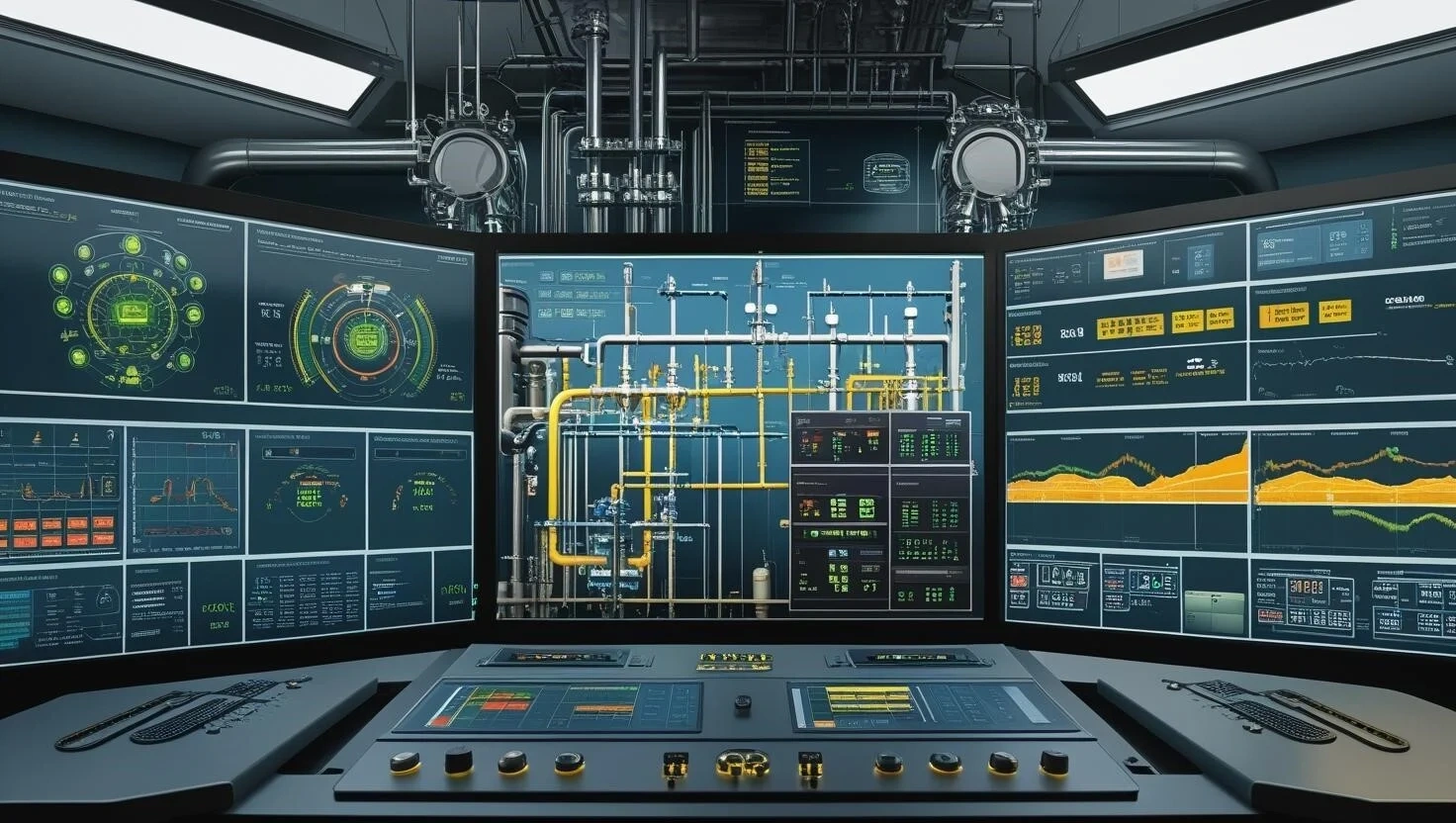
Industrial plants already have plenty of automation. Refineries, petrochemical plants, gas facilities and hydrogen units are controlled by DCS platforms, supported by APC applications, monitored by historians and, in many cases, optimised by RTO systems. These layers are essential. They keep plants safe, stable and commercially useful.
Yet modern industry still faces a familiar problem: the plant often gives early warnings before the alarm system does, but those warnings are hidden inside complex process behaviour.
A reactor profile changes shape. A crude feed property shifts before the laboratory result arrives. A gas quality parameter starts drifting. A distillation column remains inside its limits, but energy use and product quality begin to move in the wrong direction. Each individual variable may still look normal. The problem is in the relationship between variables.
Modcon.AI is an advanced process analysis and optimisation layer designed to sit above existing DCS, APC and RTO systems. It uses time-series AI, multivariate anomaly detection and Deep Reinforcement Learning to learn plant behaviour, identify early deviations and support better operating decisions. The platform is not intended to replace established control systems. It is designed to make them more informed.
The important point is that Modcon.AI is grounded in real process data, including online process analyzer measurements. Without reliable live measurements of composition, physical properties and product quality, any optimisation layer is partly guessing. In process industries, guessing is not a strategy. It is usually the start of a meeting.
Why another layer is needed
DCS, APC and RTO systems each have a defined role.
The DCS provides direct control, operator interface, alarms, interlocks and safe plant operation. APC reduces variability around known constraints and helps stabilise multivariable processes. RTO supports economic optimisation, usually based on models, constraints and planning targets.
These systems remain valuable, but many were designed around relatively fixed assumptions: known process models, defined operating envelopes and stable process relationships. That becomes harder when plants must handle more variable feedstocks, tighter specifications, energy pressure, product changes, sustainability targets and higher safety expectations.
Modern refineries may process a wider crude slate and need to switch crude sources more often. Gas facilities may need tighter control of composition, Wobbe Index, calorific value, oxygen, H₂S, CO₂ or hydrocarbon dew point. Hydrogen production and blending systems require fast, reliable information on gas quality and safety-related impurities. Petrochemical reactors may operate across multiple products, grades and catalyst conditions.
In these conditions, the process may change faster than traditional optimisation models can comfortably follow.
Modcon.AI addresses this by continuously learning from live plant data. Instead of relying only on fixed limits and static models, it analyses how process variables behave together over time.
Process analyzers as the foundation of industrial AI
Industrial AI needs data, but not just any data. It needs data that represents the real process. It needs measurements that arrive fast enough to support action. It needs information about the chemical and physical condition of the process, not only pressure, flow and temperature.
This is where process analyzers become central. Online process analyzers provide continuous information about composition, product quality and physical properties. Depending on the application, this may include crude oil properties, fuel gas quality, hydrogen purity, oxygen concentration, salt in crude, sulphur, water, density, viscosity, RVP, Wobbe Index, calorific value or other process-critical parameters.
These values often explain plant behaviour more directly than conventional instrumentation alone. Flow, pressure and temperature tell the control system what the plant is doing mechanically. Process analyzers help explain what the material inside the plant actually is.
That distinction is vital for AI optimisation. A refinery crude distillation unit cannot be properly optimised if the optimiser does not know that the crude quality has changed. A blending system cannot minimise giveaway if final product quality is only confirmed after the blend is complete. A hydrogen or gas system cannot manage safety and product quality well if impurities are detected too late.
Modcon.AI uses analyzer data, process instrumentation, historian data and control system information to create a more complete picture of plant behaviour.
From fixed alarms to process behaviour
Traditional alarm systems are usually based on individual limits. A temperature is too high. A pressure is too low. A flow is outside its operating range. This is necessary for safe operation, but it is a blunt tool for early detection.
Many process problems begin before fixed limits are crossed.
For example, a reactor temperature may still be within its normal range, but its profile may no longer match the expected behaviour for the current product and operating mode. A pressure may be acceptable, but unusual when compared with flow, composition and cooling duty. A column may look stable from one panel view, while the combination of energy use, cut point movement and product properties suggests that efficiency is slipping.
Multivariate anomaly detection is designed to detect this kind of behaviour. It does not only ask whether one variable is high or low. It asks whether a group of variables still makes sense together.
This is a more useful question for real plants.
Multivariate anomalies often appear before alarm storms. By the time a plant is in alarm flood, operators must separate causes from consequences while the situation is already developing. Earlier detection gives them more time to investigate, reduce feed, adjust cooling, verify analyser data, change setpoints or stabilise the process before it becomes an incident.
In simple terms, Modcon.AI is designed to hear the plant clearing its throat before it starts shouting.
Dynamic limits for changing operations
Fixed limits are useful, but they do not fully reflect how plants operate.
A reactor running one product at one load may have a completely different normal profile from the same reactor running another product. A batch process may have several phases, each with its own expected trajectory. A CDU during crude switching behaves differently from a CDU running a steady feed. Gas quality limits may depend on downstream users, pipeline requirements or turbine sensitivity.
Static alarms cannot easily describe all these states.
Modcon.AI dynamic limits are intended to model expected behaviour in real time. The system learns normal operating patterns across multiple assets, product types, batch combinations or process modes. When the plant starts moving away from its expected path, the system can surface the deviation before conventional limits are crossed.
This can be especially useful in reactor operations, where small changes in heat release, catalyst behaviour, cooling efficiency or feed composition may have large consequences. It is also valuable in continuous processes where gradual drift can quietly reduce energy efficiency, product quality or equipment reliability.
Time-series AI for live process operations
Process plants are time-series systems. They move, drift, respond, recover and occasionally misbehave with considerable imagination.
A useful AI model for process optimisation must understand this behaviour over time. It must recognise trajectories, delays, correlations, operating modes and constraints. It must know whether a current pattern is normal for the present conditions, not simply whether one tag is above or below a fixed value.
This is the role of time-series AI.
Modcon.AI applies time-series analysis to live industrial data. It learns from historical operation, compares expected and actual behaviour and identifies early deviations. This supports process health analysis, fault detection, energy optimisation and operating guidance.
The practical value is not another dashboard. The value is earlier and clearer insight into what the process is doing.
DRL above DCS, APC and RTO
Deep Reinforcement Learning is one of the more advanced methods used in modern optimisation. In industrial applications, it must be applied carefully.
A plant is not a software simulation where an algorithm can try random actions and see what happens. Real equipment has pressure limits, safety rules, environmental requirements, product specifications and commercial consequences. Any DRL-based system must work within defined operating boundaries and respect the existing automation and safety layers.
In Modcon.AI, DRL is used as a higher-level optimisation approach. It learns relationships between process states, possible actions and outcomes. It can evaluate operating strategies that improve yield, reduce energy use, stabilise quality or lower variability.
This makes DRL relevant for nonlinear and multivariable processes where conventional models may be difficult to maintain. Examples include crude distillation, refinery blending, reactor optimisation, gas quality control, hydrogen production and energy-intensive separation systems.
The DRL layer does not replace the DCS. It does not make safety systems optional. It works above the existing control structure, supporting improved decisions and setpoint optimisation while the established automation layers continue to perform direct control and protection functions.
CDU optimisation: why live crude data matters
Crude distillation is a good example of why AI optimisation needs real-time analyzer data.
A CDU is affected by crude density, viscosity, sulphur, boiling range, water, salt, light ends and other properties. These parameters influence furnace duty, column temperature profiles, product cut points, pumparound performance, stripping efficiency and product quality.
Traditional CDU optimisation often relies on crude assays, laboratory results, simulation models and steady-state assumptions. These are useful, but they cannot fully capture rapid crude variability or crude switching events. When the feed changes, the unit needs to respond while the change is happening.
Modcon.AI CDU optimisation uses real-time crude quality information to support adaptive setpoint recommendations. Online analyzers provide live measurements of key crude properties. The AI layer interprets how the CDU should respond. The optimisation model identifies better operating targets. The existing control system then applies approved actions within plant constraints.
This creates a practical closed loop between measurement, analysis and optimisation.
The result is a more responsive approach to CDU operation, especially where crude quality changes affect energy use, product yield and quality control.
Advanced blending and product quality
Blending is another area where delayed data can be expensive.
In gasoline, diesel, fuel oil, bunker fuel or crude blending, the commercial objective is usually to meet specification at minimum cost. Over-blending creates giveaway. Under-blending creates off-spec risk. Waiting for laboratory confirmation may mean that corrective action arrives after the material has already been produced.
Online process analyzers allow the blend quality to be measured during production. Modcon.AI can use this live information to support optimisation of component ratios, reduce giveaway and help maintain product quality closer to target.
This is particularly important when feed components vary or when lower-cost components are being used near specification limits. The aim is not simply to automate blending. The aim is to make better decisions while the blend can still be corrected.
Process health analysis and predictive maintenance
Not all AI value comes from direct optimisation. Some of the strongest value comes from recognising that something is starting to go wrong.
Process health analysis uses AI models to learn normal behaviour and detect early signs of deterioration. These may include fouling, catalyst ageing, heat exchanger performance loss, analyser drift, valve problems, abnormal reaction behaviour, pump inefficiency or poor control loop performance.
Many of these issues develop gradually. They may not trigger alarms at first. They simply make the process less efficient, less stable or harder to control.
By detecting abnormal patterns early, Modcon.AI helps operators and maintenance teams decide whether to inspect equipment, adjust operating conditions, clean a system, verify measurement quality or plan intervention before failure occurs.
This supports predictive maintenance based on actual process condition, not only calendar intervals.
More signal, less noise
One of the biggest problems in modern control rooms is not lack of information. It is too much poorly filtered information.
Operators may face hundreds or thousands of tags, alarms, trends and reports. Many are useful. Many are background noise. During abnormal operation, the noise problem gets worse.
Modcon.AI aims to surface fewer but more meaningful signals. Multivariate anomaly detection helps identify patterns that matter because they are unusual for the current process state. Dynamic limits reduce dependence on simplistic thresholds. Time-series modelling provides context. Analyzer data adds process meaning.
This helps operators focus on the behaviour that requires attention, rather than manually searching for weak signals across many screens.
Why measurement quality still decides everything
Industrial AI can be powerful, but it cannot escape poor measurement.
If the sample system is slow, the analyser is not representative, the calibration is poor or the data is not time-aligned, the AI model will learn from distorted information. A model can produce very confident conclusions from bad data. This is not intelligence. It is automation with a straight face.
For this reason, Modcon.AI should be understood together with process analytical engineering. Analyzer selection, sample point location, sample conditioning, response time, calibration, validation and communication with the control system all matter.
The AI layer is only as strong as the measurement layer beneath it.
A practical architecture for modern plants
A practical industrial AI architecture does not fight the existing control hierarchy. It strengthens it.
The DCS remains responsible for direct control, operator interface and safety-related actions.
APC stabilises multivariable control and reduces variability around known constraints.
RTO supports economic optimisation and planning objectives.
Process analyzers provide live data on composition, physical properties and product quality.
Modcon.AI sits above these layers, learning process behaviour, detecting multivariate anomalies, modelling dynamic limits and supporting DRL-based optimisation.
This layered architecture allows plants to improve performance without discarding established systems. It adds adaptive intelligence where traditional automation is weakest: early detection, nonlinear behaviour, live composition changes and dynamic optimisation.
Conclusion
The next step in process optimisation is not simply more automation. Most plants already have enough systems. The real need is better process intelligence.
Modcon.AI addresses this by combining time-series AI, multivariate anomaly detection, dynamic limits and DRL-based optimisation in a layer above DCS, APC and RTO. The system is grounded in real-time process analyzer data, which provides the live composition and property measurements needed for reliable industrial AI.
For refineries, gas plants, hydrogen systems, petrochemical units and other process industries, this approach supports earlier detection, lower variability, improved quality control, reduced energy use and better operating decisions.
When minutes matter, the plant does not need another after-the-event explanation. It needs trusted measurements, early warning and adaptive optimisation while there is still time to act.
That is the role of Modcon.AI.